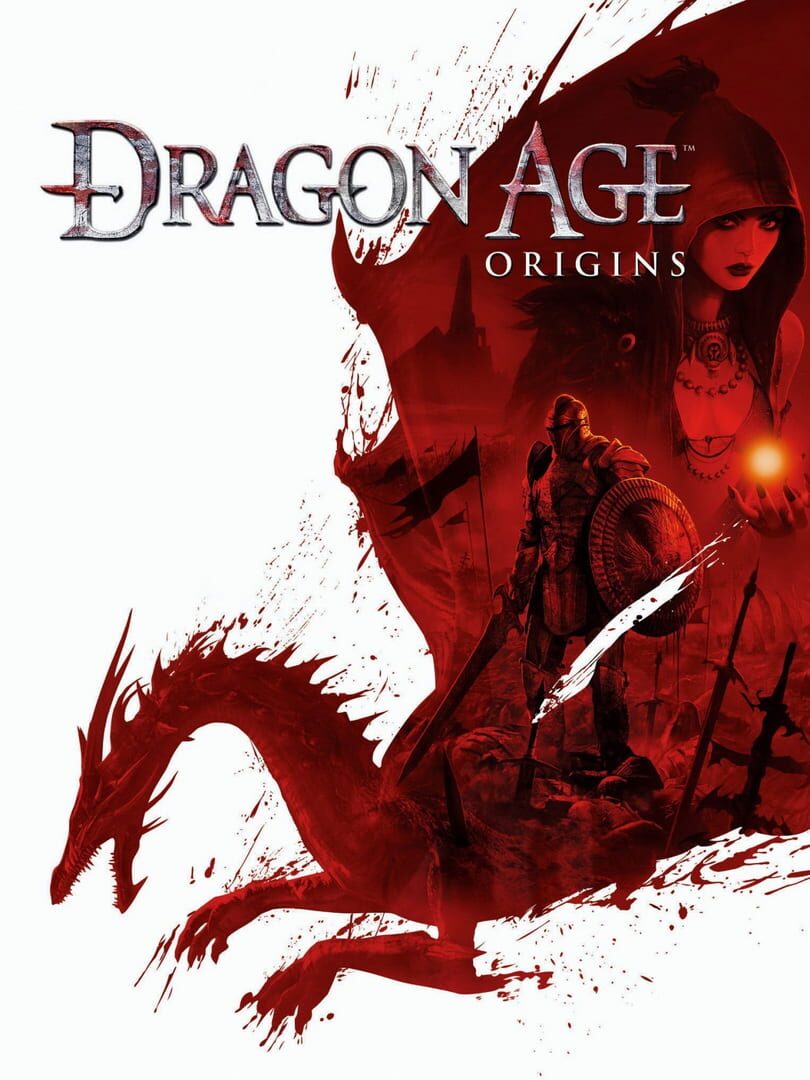
The kingdom of Ferelden is experiencing civil war and political unrest. Play as a warrior, mage or rogue of human, elven or dwarven origin. Recruited into the Grey Wardens, an ancient order dedicated to fighting the monstrous Darkspawn, you must confront their invasion and defeat the Archdemon commanding them to bring this threat to an end.
Video game
2009
Action
Fantasy
RPG
Open world
Dragon Age: Origins
- BioWare Edmonton Developer
- Electronic Arts Publisher
Six origins, a kingdom under threat and choices that shape a destiny.
Details
- Type
- Video game
- Release
- November 3, 2009
- Countries
- 🇨🇦 Canada
- Genres
- Action, Fantasy, RPG, Open world
- Platforms
- PlayStation 3, PC, Xbox 360, Mac
- Engine
- Eclipse Engine (BioWare)
- Game modes
- Single player
Synopsis
Dragon Age: Origins


Trailer
Watch the trailer
Overview
Presentation
Developed by BioWare Edmonton and published by Electronic Arts, Dragon Age: Origins is a role-playing game released on November 3, 2009. The first installment in the Dragon Age series, it takes place in the kingdom of Ferelden, on the continent of Thedas. This dark fantasy setting faces political unrest and an invasion by the Darkspawn, monstrous creatures commanded by an Archdemon. The protagonist joins the Grey Wardens, an ancient order dedicated to fighting this threat. The adventure combines exploration, dialogue, strategic combat and decisions that can affect character relationships and the outcome of numerous situations. Its structure follows the tradition of party-based role-playing games developed by BioWare, particularly Baldur's Gate, without using the rules of Dungeons & Dragons.
One of the game's defining features is its system of six playable origin stories, which gives Origins its title. During character creation, players choose their hero's gender, appearance, race and class from Warrior, Rogue and Mage. The three available races are humans, elves and dwarves, although certain combinations are restricted: dwarves, for example, cannot become mages. The six backgrounds are Human Noble, Circle Mage, City Elf, Dalish Elf, Dwarf Commoner and Dwarf Noble. Each begins in a different environment, with its own characters, events and social conflicts. These introductions eventually lead into the main adventure, but the chosen origin continues to influence dialogue, certain encounters and the way the world responds to the protagonist.
Combat takes place in real time with the option to pause the action. The active party contains up to four characters, including the player-created hero. Each can receive direct orders, use abilities or move to a specific position. On PC, an elevated camera also provides a tactical overview of the battlefield. Warriors can absorb damage or fight in close combat, Rogues rely on positioning, backstabbing and ranged attacks, while Mages use offensive, defensive and support spells. Abilities consume stamina or mana, and certain area attacks can also harm allies depending on the selected difficulty settings. Movement, resource management and the order in which abilities are activated are therefore essential considerations.
Programmable companion tactics provide another central mechanic. Players can establish conditional rules governing automated behavior: healing an ally when their health falls below a particular threshold, attacking a specific enemy or protecting a threatened companion. Rules are evaluated in their assigned order, allowing detailed strategies without requiring constant direct control of every fighter. Progression relies on experience earned through combat and quests. Characters improve their attributes, learn talents or spells and can unlock different specializations. Weapons, armor and accessories also affect their performance. Additional skills, including potion brewing, poison-making and trap construction, expand the available preparation options.
Exploration leads through several regions of Ferelden, accessed using a world map. Players visit cities, villages, forests, fortresses and underground locations containing quests, inhabitants, merchants and enemies. Rather than featuring a single continuous open world, the game uses distinct areas connected through map travel. Investigations, conversations and battles frequently offer different ways to resolve a situation. Choices are not limited to an explicit distinction between good and evil: they can involve political interests, personal convictions or consequences that are difficult to anticipate. The adventure therefore develops differently according to the decisions made throughout the journey.
Companions possess their own personalities, beliefs and personal histories. Some approve of the protagonist's decisions, while others openly disagree. This approval system affects conversations, access to personal quests and, for certain characters, opportunities for romance. The party camp provides a place to rest, discuss personal matters, change the party and manage equipment. Gifts discovered or purchased during the adventure can also influence relationships. Built using BioWare's Eclipse Engine, Dragon Age: Origins features a dark fantasy visual style accompanied by an original soundtrack composed by Inon Zur. A separate expansion campaign, Dragon Age: Origins – Awakening, and several downloadable content packs later extended the experience.
Key Highlights
- Six distinct origin stories: the protagonist's background determines their introduction and influences interactions throughout the adventure.
- A choice-driven RPG: dialogue, political conflicts and moral decisions can lead to different consequences.
- Real-time combat with tactical pausing: players control up to four characters and coordinate movement, spells and abilities.
- Programmable behaviors: tactical settings define companions' automated actions according to specific conditions.
- Customizable progression: classes, specializations, attributes, talents and equipment determine character abilities.
- Companions with evolving relationships: approval, conversations, personal quests and romances contribute to party development.
- Structured exploration of Ferelden: cities, forests, fortresses and underground environments feature varied missions and encounters.
Conclusion
Dragon Age: Origins combines branching storytelling with the mechanics of a tactical role-playing game focused on party management. Its six origin stories provide the protagonist with a background that continues to influence their journey, while decisions made throughout the adventure affect relationships and certain political situations. Combat pausing, programmable tactics and character specializations allow players to develop different strategies. This combination of narrative customization and party coordination establishes the foundations of the Dragon Age series.
Did You Know?
- The game features six playable origins: Human Noble, Circle Mage, City Elf, Dalish Elf, Dwarf Commoner and Dwarf Noble. Each has its own introductory storyline.
- The three starting classes are Warrior, Rogue and Mage. Dwarves cannot choose the Mage class.
- The active party contains four characters, including the protagonist. Players can switch directly between party members during combat.
- The protagonist can obtain two specializations, at levels 7 and 14, after meeting their respective unlocking requirements.
- Automated combat tactics use configurable conditions and actions. The number of available slots increases through the Combat Tactics skill.
- The approval system can change dialogue, unlock personal quests and enable certain romances. Severely damaged relationships can also cause companions to leave.
- Crafting skills include Herbalism, Poison-Making and Trap-Making. Recipes and collected materials determine which items can be produced.
- The game uses BioWare's Eclipse Engine, with an original soundtrack composed by Inon Zur.
- The Dragon Age: Origins – Awakening expansion, released in 2010, features a new campaign. The Ultimate Edition includes the original game, this expansion and additional downloadable content.
Link graph
Open in the full graphLoading the graph…
Only the strongest links are shown.