Twenty years after the previous conflict, Earth has changed dramatically. Tiberium continues to spread, contaminating entire regions and making much of the world uninhabitable. To survive, GDI has retreated toward the Arctic regions, while the Brotherhood of Nod has established underground facilities. Their ambitions remain opposed. GDI seeks to preserve world peace and discover the origins of Tiberium. Nod continues its pursuit of global domination, despite the disorder caused by Kane's presumed disappearance at the end of the First Tiberium War. Deprived of its leader, the Brotherhood develops powerful units through genetic mutations involving Tiberium. In this rapidly changing world, the struggle between the two organizations continues.

Video game
1999
Science fiction
Strategy
Real-time strategy
Command & Conquer 2: Tiberian Sun
- Electronic Arts Publisher
- Mastertronic Games Publisher
- Sold Out Sales & Marketing Publisher
- Westwood Studios Developer
- ak tronic Software & Services Publisher
Tiberium is transforming Earth. The war for its future continues.
Details
- Type
- Video game
- Release
- August 20, 1999
- Countries
- 🇺🇸 United States
- Genres
- Science fiction, Strategy, Real-time strategy
- Platforms
- PC
- Game modes
- Single player, Multiplayer
Synopsis
Command & Conquer 2: Tiberian Sun
Trailer
Watch the trailer
Overview
Presentation
Developed by Westwood Studios and published by Electronic Arts, Command & Conquer: Tiberian Sun is a real-time strategy game released on August 20, 1999. A sequel to Command & Conquer (1995), it returns to the conflict between the Global Defense Initiative (GDI) and the Brotherhood of Nod in a future where the spread of Tiberium is transforming Earth's environment. Contaminated regions become hazardous, organisms mutate, and both organizations develop new military technologies. Players choose either the GDI or Nod campaign, each featuring different missions and perspectives on the conflict. Progression combines military objectives, exploration of hostile regions and filmed narrative sequences.
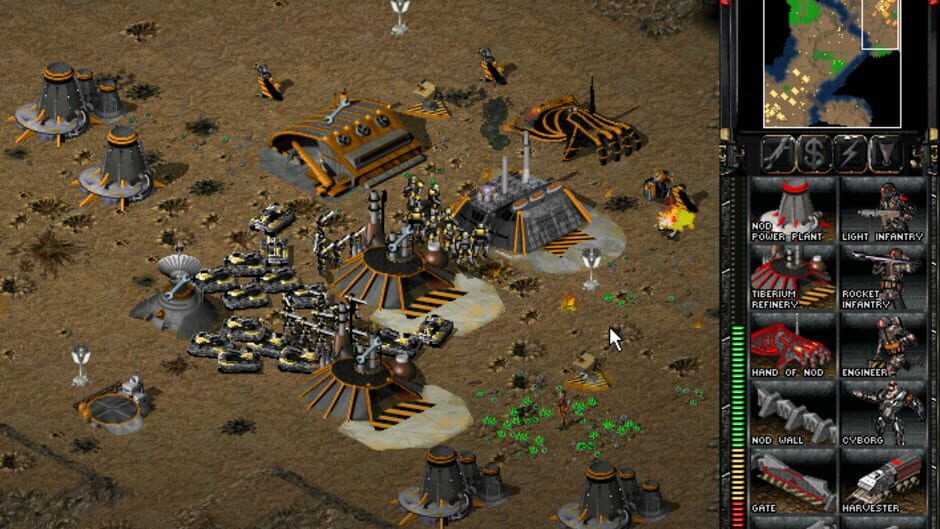
The game retains the series' core systems: base construction, resource gathering and real-time army control. A Mobile Construction Vehicle deploys into a Construction Yard, allowing players to establish power plants, refineries, military facilities and defensive structures. Harvesters collect Tiberium, which is converted into credits to finance buildings and units. Two main varieties are available: common green Tiberium and more valuable but unstable blue Tiberium. Campaigns also feature optional secondary missions that can make certain main operations easier. Unit management evolves through a veterancy system that improves the abilities of troops as they gain combat experience.
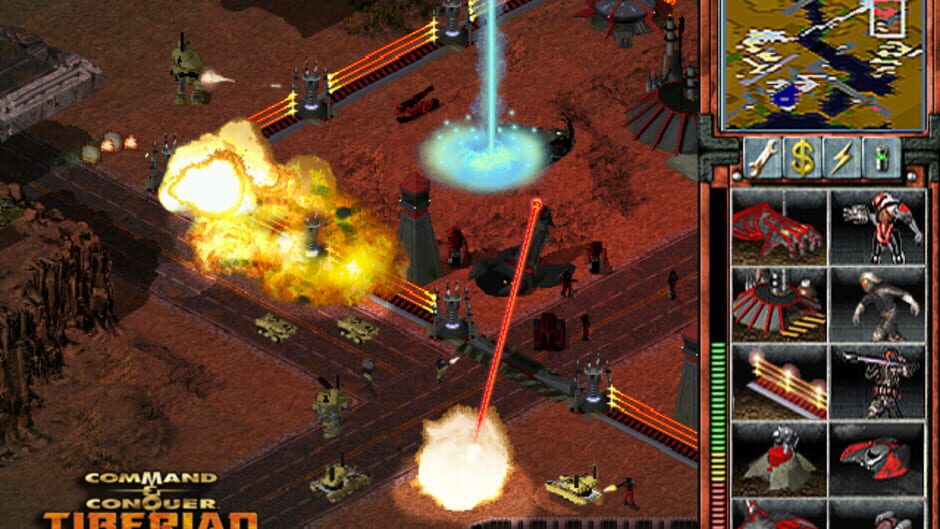
The factions possess distinct military arsenals. GDI emphasizes heavy forces and advanced combat technology, including Titan and Wolverine mechanized walkers, jump jet infantry, amphibious transports and hover vehicles. Nod employs cyborgs, stealth vehicles, subterranean transports and specialized defensive equipment. These differences influence both offensive tactics and base protection. Engineers can capture enemy structures, while reconnaissance units and detection systems become important when defending against infiltration.
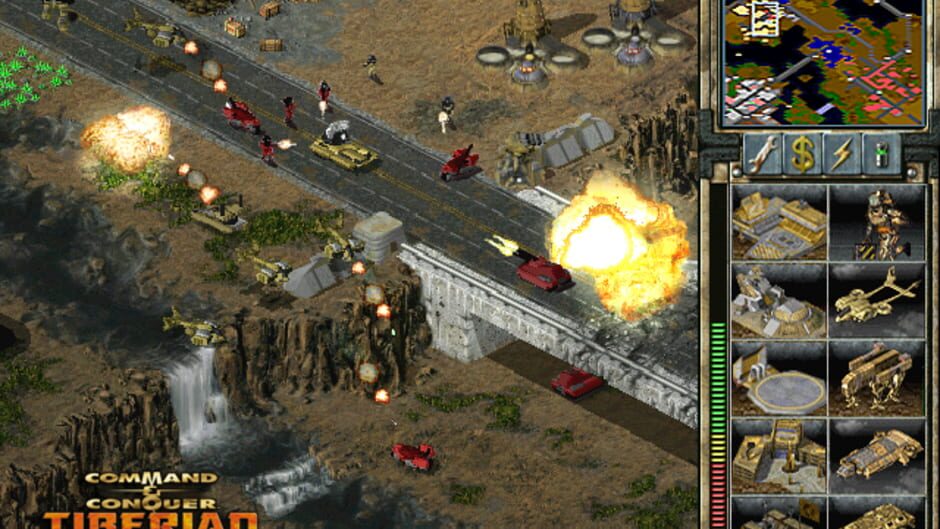
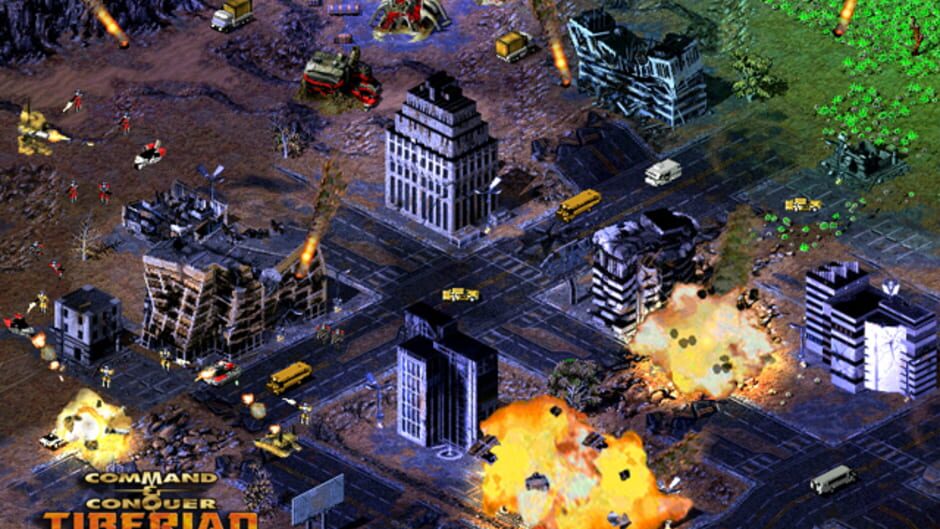
The environment is one of the installment's major advancements. Maps use an isometric perspective, incorporating varied elevation, changing lighting and destructible features. Explosions can deform certain terrain, bridges can be destroyed and repaired, and fires can spread through forests. Ion storms disrupt radar systems and aerial operations, requiring players to adapt their movements. Battles can also take place at night, with searchlights and lighting effects contributing to the depiction of a contaminated world.
The story retains the live-action cinematics characteristic of Command & Conquer. Its cast includes Michael Biehn, James Earl Jones and Joseph D. Kucan, who portrays Kane. Multiplayer battles complement the single-player campaigns. In 2000, the Firestorm expansion introduced additional campaigns, new units and a continuation of the storyline. This content is separate from the original 1999 release.
Key Highlights
- The return of the GDI–Nod conflict: two campaigns explore opposing objectives and perspectives in a world transformed by Tiberium.
- Resource gathering and base construction: refineries, electricity, military production and defensive structures support battlefield operations.
- Asymmetric futuristic units: GDI walkers and amphibious vehicles face Nod stealth technology, subterranean transports and cyborgs.
- Dynamic battlefields: destructible terrain, bridges, spreading fires and ion storms influence tactical decisions.
- Unit progression: experienced soldiers and vehicles can develop enhanced combat capabilities.
- Cinematic storytelling: live-action performances, branching mission choices and a science-fiction atmosphere accompany both campaigns.
Conclusion
Command & Conquer: Tiberian Sun expands the universe of the original game by making the environmental consequences of Tiberium contamination central to the conflict. Its distinct factions, futuristic units and dynamic environments deepen base construction and real-time combat. The campaigns and filmed sequences also develop the narrative dimension of the series.
Did You Know?
- The game takes place after the First Tiberium War, in a world profoundly altered by the continuing spread of the alien substance.
- Blue Tiberium is more valuable than green Tiberium, but its crystals can explode when damaged.
- Ion storms can disable radar systems, prevent aerial operations and cause lightning strikes across the battlefield.
- Certain explosions deform terrain. Engineers can repair destroyed bridges by interacting with their control structures.
- The game's vehicles and buildings use voxel-based graphics, while infantry uses sprites, within an isometric environment.
- The campaigns include optional secondary missions. Completing them can make a main mission easier by providing reinforcements or weakening enemy forces.
- The soundtrack was composed by Frank Klepacki and Jarrid Mendelson, emphasizing electronic and atmospheric music.
- The Firestorm expansion, released in 2000, adds GDI and Nod campaigns along with new units. It was not part of the original game.
- Electronic Arts released the game and its expansion as freeware in 2010. Their arrival on Steam in March 2024 represents a new distribution rather than the original release.
Link graph
Open in the full graphLoading the graph…
Only the strongest links are shown.