Presentation
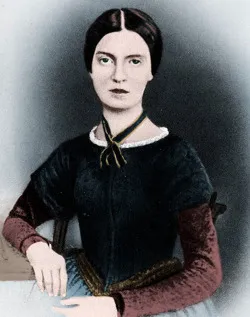
Emily Dickinson, born on December 10, 1830, in Amherst, Massachusetts, and deceased on May 15, 1886, in the same town, was an American poet regarded as one of the most original figures in nineteenth-century literature. Her work, comprising nearly 1,800 poems, is distinguished by extraordinary expressive intensity and a deeply personal approach to the mysteries of existence. Death, immortality, faith, love, solitude, and the smallest manifestations of nature become subjects of reflection in which wonder, uncertainty, and irony converge. Her poetry resists easy answers and transforms ordinary experiences into universal questions.
Dickinson's poetry is immediately recognizable through its short lines, dashes, unexpected capitalization, and frequently unconventional rhymes. She drew inspiration from the rhythms of Protestant hymns while reshaping their conventions to create a poetic language of remarkable freedom. Words constantly suggest multiple interpretations, while silences and interruptions contribute directly to meaning. A flower, a bird, a shaft of light, or a familiar landscape may become an image of memory, desire, or disappearance. Her attention to the details of the natural world never stops at their visible beauty: it also reveals the complexity of emotion and the uncertainty of the human condition.
The originality of her writing also lies in the way it brings opposing ideas into dialogue: presence and absence, belief and doubt, life and death, confinement and freedom. Her poems rarely develop arguments in a conventional sequence; instead, they concentrate intellectual and emotional experiences into a few lines, sometimes approaching the mysterious or enigmatic. Modern editions of her collected poems have made this exceptional body of writing accessible, although it remained almost entirely in manuscript form during her lifetime. Despite living far from literary celebrity, Dickinson is now recognized as a pioneer of poetic modernity, whose formal experiments opened new possibilities for literary expression.
Career
Emily Elizabeth Dickinson was born into a prominent Amherst family. Her father, Edward Dickinson, was a lawyer and politician, while her mother, Emily Norcross Dickinson, was closely involved in family life. She grew up alongside her older brother Austin and younger sister Lavinia in an environment where education, religion, and civic responsibilities played important roles. At Amherst Academy, she received a substantial education that included natural sciences, literature, and languages. In 1847, she entered Mount Holyoke Female Seminary, an institution of higher education for women, which she left after one year. Her intellectual curiosity was accompanied by a deep interest in botany, gardening, and reading, passions that would continue to nourish her imagination.
From the mid-1850s onward, Dickinson devoted an increasing part of her life to poetry. Her most intensive period of composition occurred approximately between 1858 and 1865, when she organized hundreds of poems into small, hand-sewn manuscript booklets, now known as fascicles. She also maintained extensive correspondence and shared selected poems with people close to her, particularly Susan Huntington Gilbert Dickinson, her friend and sister-in-law, who played an important role in her intellectual life. In 1862, she began corresponding with the writer and critic Thomas Wentworth Higginson, sending him examples of her poetry. Over time, she gradually limited her travels and preferred the privacy of her family home, without entirely withdrawing from the outside world, which she continued to engage through books and letters.
During the final decades of her life, Dickinson continued writing while experiencing personal losses and health difficulties. She died in Amherst in 1886, aged fifty-five. Only about ten of her poems had appeared in print during her lifetime, anonymously and often with editorial alterations. Following her death, her sister Lavinia discovered a remarkable collection of manuscripts and determined that they should become known. The first collection appeared in 1890 through the efforts of Mabel Loomis Todd and Thomas Wentworth Higginson, although the poems were extensively adapted to the literary conventions of their period. It was not until twentieth-century scholarly editions, particularly Thomas H. Johnson's edition in 1955, that readers encountered versions much closer to Dickinson's original writing. This rediscovery profoundly transformed her position in literary history.
Key Facts
- A body of poetry largely revealed after her death: Emily Dickinson composed nearly 1,800 poems, but only a very small proportion appeared during her lifetime. Her sister Lavinia's discovery of the manuscripts brought to light a body of writing whose scale and originality had been almost entirely unknown to her contemporaries.
- Punctuation as a poetic signature: her dashes, unexpected capital letters, and imperfect rhymes help construct meaning. Far from being simple irregularities, these features give her verses a distinctive rhythm and create possibilities of interpretation that early editions frequently obscured.
- A private life enriched by intellectual exchange: although Dickinson gradually withdrew from public life, she maintained meaningful intellectual and emotional relationships through correspondence. Her exchanges with Susan Dickinson, Thomas Wentworth Higginson, and several friends reveal an inner life nourished by dialogue and reading.
- Nature as a philosophical language: deeply interested in botany and gardening, she observed flowers, insects, birds, and the changing seasons with extraordinary attention. These natural details became images of transformation, fragility, and the mysteries of existence throughout her poetry.
- A pioneer of modern poetry: through her concision, formal experimentation, and resistance to definitive conclusions, Dickinson anticipated several major concerns of twentieth-century poetry. Her work continues to inspire writers, translators, and scholars, particularly through the alternative wordings and textual variations preserved in her manuscripts.