
Presentation
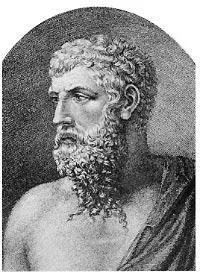
Aristophanes, born around the middle of the fifth century BCE and deceased in the early fourth century BCE, was an Athenian comic playwright and poet widely regarded as the greatest representative of Greek Old Comedy. Living through the Peloponnesian War and major political transformations in Athens, he turned the theatre into a space for criticism, where institutions, military commanders, philosophers, and ordinary citizens became targets of fearless satire. His plays combine political debate, extravagant situations, choral performances, and sometimes obscene jokes, creating a dramatic art in which laughter serves both entertainment and civic reflection.
In Lysistrata, performed in 411 BCE, women from several Greek cities decide to withhold sexual relations from their husbands in an attempt to force an end to the war. Beneath this comic premise, Aristophanes exposes the exhaustion caused by military conflict and imagines women intervening in affairs traditionally controlled by men. Assemblywomen, written in the early fourth century BCE, takes this reversal of social roles further: Athenian women seize control of political institutions and propose a communal organization of wealth and everyday life. The play explores the possibilities and contradictions of a radically reorganized society through comedy.
With The Knights, performed in 424 BCE, Aristophanes directly attacks Athenian politics by ridiculing the influential demagogue Cleon, portrayed through a manipulative character attempting to dominate the people. His plays frequently rely on spectacular reversals: powerful figures become ridiculous, ordinary citizens challenge authority, and the most improbable solutions are offered to collective crises. Through these techniques, Aristophanes transforms comic theatre into a distorted mirror of democracy, exposing both its freedoms and its underlying tensions.
Career
Relatively little is known with certainty about Aristophanes' personal life. Ancient sources identify him as an Athenian citizen, the son of a man named Philippos, belonging to the deme of Kydathenaion. His birth is generally placed between 450 and 445 BCE, although neither the exact year nor the precise birthplace can be established. He grew up in an Athens experiencing remarkable intellectual and artistic development alongside the increasing tensions that eventually led to the Peloponnesian War in 431 BCE. This period of political rivalry and military conflict provided the principal historical background for his theatrical work.
Aristophanes began competing in Athenian dramatic festivals in 427 BCE with a now-lost comedy, The Banqueters. He soon achieved success at religious festivals honoring Dionysus, where playwrights presented their works before the citizen audience. In 425 BCE, The Acharnians won first prize at the Lenaia, followed the next year by The Knights. His attacks on Cleon, an influential figure in Athenian democracy, generated considerable tension and, according to several ancient accounts, threats of legal action. Nevertheless, Aristophanes continued his remarkably outspoken satire, targeting political leaders, intellectual fashions, and judicial practices.
His career extended across several decades, encompassing Athens' defeat by Sparta in 404 BCE and the transformation of Greek society during the early fourth century. His dramatic style gradually evolved: after direct political attacks and elaborate choral confrontations, his later surviving plays gave greater prominence to social plots and collective situations. Assemblywomen, performed around 392 or 391 BCE, illustrates this transition, while Wealth, produced in 388 BCE, is his latest surviving work. Ancient sources attribute approximately forty plays to Aristophanes, of which only eleven survive in substantially complete form. His death is generally placed a few years after 388 BCE, although its precise date remains unknown.
Key Facts
- The principal surviving voice of Old Comedy: Aristophanes is the only playwright of Athenian Old Comedy whose complete plays have survived. His eleven extant comedies reveal a theatrical form in which choral performances, personal attacks, fantasy, and political criticism played essential roles.
- Satire at the heart of Athenian democracy: his plays openly attacked politicians, institutions, and collective decisions. This outspoken style illustrates the freedoms available within theatrical competitions, although his criticism should not be mistaken for a consistent political program.
- Women overturning the established order: in Lysistrata and Assemblywomen, Aristophanes gives female characters extraordinary political initiatives. These reversals question established power structures without necessarily making their author an advocate of gender equality in the modern sense.
- Inventive and provocative humor: wordplay, obscenity, caricature, disguises, and impossible situations are central to his dramatic language. Aristophanes repeatedly overturns theatrical conventions to confront audiences with the contradictions of collective life.
- A lasting legacy in political satire: his plays helped establish a theatrical tradition in which laughter becomes an instrument of social criticism. Their influence extends to political comedy, caricature, satirical theatre, and many modern forms of irreverent humor.