What if Adolf Hitler had never existed? Seeking to change history, Albert Einstein builds a time machine and eliminates the future dictator as a young man, preventing World War II as we know it. But by removing one threat, Einstein creates another. Joseph Stalin's Soviet Union is now preparing to conquer Europe, and the Allies must unite to stop its expansion.
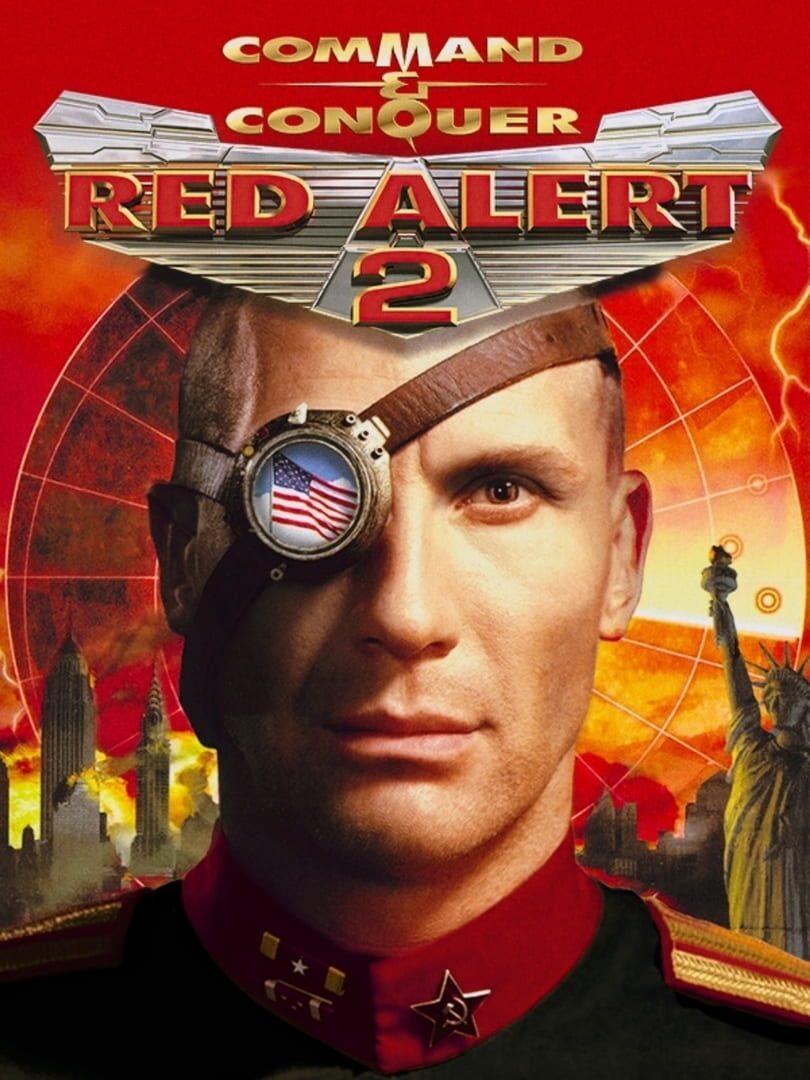
Video game
2000
Science fiction
Fantasy
Historical
Strategy
Real-time strategy
Command & Conquer: Red Alert 2
- Electronic Arts Publisher
- Westwood Pacific Developer
A rewritten history, two superpowers and a war without limits.
Details
- Type
- Video game
- Release
- October 25, 2000
- Countries
- 🇺🇸 United States
- Genres
- Science fiction, Fantasy, Historical, Strategy, Real-time strategy
- Platforms
- PC
- Game modes
- Single player, Multiplayer
Synopsis
Command & Conquer: Red Alert 2


Trailer
Watch the trailer
Overview
Presentation
Developed by Westwood Pacific and published by Electronic Arts, Command & Conquer: Red Alert 2 is a real-time strategy game released on October 25, 2000. A sequel to Command & Conquer: Red Alert (1996), it returns to an alternate-history universe created by Albert Einstein's intervention in the past. The second game's storyline follows the events of the first Allied campaign and depicts a Soviet invasion of the United States. Players can follow either an Allied or Soviet campaign, each comprising twelve missions accompanied by live-action cinematics. Operations take place in American cities and other locations, featuring military engagements, strategic facilities and experimental technologies.
The gameplay retains the defining systems of Command & Conquer: base construction, resource gathering and real-time unit control. Players deploy Mobile Construction Vehicles, build power plants, refineries, barracks and factories, and organize military production. Miners collect ore and gems, converting them into credits to finance buildings and troops. Some maps contain oil derricks that provide a steady income once captured. Base development must be coordinated with exploration, defense and attacks against enemy positions. Engineers can seize opposing structures or repair destroyed bridges.
The Allies and Soviets possess very different military forces. The Allies employ advanced technologies, including Prism Tanks, Mirage Tanks, jetpack-equipped infantry and Chrono Legionnaires. Their arsenal also features the Chronosphere and a machine capable of generating devastating storms. Soviet forces emphasize heavy armor, Kirov Airships, Tesla Coils, nuclear missiles and Terror Drones. They also possess units specializing in psychic mind control. At sea, destroyers, aircraft carriers, submarines and other specialized units create additional tactical options. This asymmetry encourages players to exploit the strengths of each side instead of following identical strategies.
Urban environments play an expanded role. Allied GIs and Soviet Conscripts can occupy certain civilian buildings and fire from their windows, turning ordinary structures into defensive positions. Bridges can be destroyed and repaired, while amphibious vehicles allow landing operations. Troops and vehicles develop through a veterancy system, gaining improved capabilities after surviving combat. In skirmish and multiplayer matches, individual Allied and Soviet countries also possess a unique unit or ability, adding further variations to the two main factions.
The story retains Westwood's tradition of live-action cinematics, with cast members including Ray Wise, Udo Kier and Kari Wuhrer. Frank Klepacki's soundtrack features Hell March 2, continuing the musical theme introduced by the original Red Alert. Beyond its single-player campaigns, the game offers skirmishes against computer opponents and multiplayer battles over local networks or the Internet. In 2001, the Yuri's Revenge expansion introduced a playable faction led by Yuri, additional campaigns and new units. These additions are separate from the original 2000 release.
Key Highlights
- A war in an alternate history: Allied and Soviet forces clash in a world transformed by Einstein's time-travel experiments.
- Two story-driven campaigns: twelve Allied and twelve Soviet missions, featuring objectives and filmed sequences specific to each side.
- A real-time military economy: ore mining, base construction, electrical power and troop recruitment support operations.
- Asymmetric factions: Allied mobility and advanced technology contrast with Soviet armor and heavy weapons.
- Expanded urban combat: occupied civilian buildings, destructible bridges and amphibious operations influence battlefield tactics.
- Experimental weapons: psychic mind control, the Chronosphere, artificial weather phenomena and nuclear weapons.
- Multiple ways to play: single-player campaigns, skirmishes and multiplayer battles with country-specific specializations.
Conclusion
Command & Conquer: Red Alert 2 expands the real-time strategy mechanics of the first Red Alert by strengthening faction differences and diversifying its battlefields. Garrisonable buildings, special abilities and futuristic units add new dimensions to land, air and naval warfare. Its live-action campaigns and alternate-history setting continue the Red Alert branch of the franchise.
Did You Know?
- The base game includes two main campaigns with twelve missions each, plus a tutorial introducing its controls and gameplay systems.
- In skirmish and multiplayer, players can select nine countries: five Allied and four Soviet, each featuring a particular military advantage.
- Allied GIs and Soviet Conscripts can garrison certain civilian buildings. The number of occupying soldiers affects the firepower of these positions.
- Engineers can capture enemy facilities, take control of oil derricks and repair damaged bridges or structures.
- Allied Chrono Miners can teleport back to their refineries, while Soviet miners possess defensive weapons.
- Units gain experience and can reach elite status, improving their combat performance.
- Yuri and psychic mind-control technologies already appear in the base game. His fully playable faction was introduced in the Yuri's Revenge expansion in 2001.
- Frank Klepacki's soundtrack includes Hell March 2, while the cinematics continue the franchise's use of live actors.
- The version available on Steam since March 2024 bundles Red Alert 2 with Yuri's Revenge. This is a later distribution of the games, not their original release date.
Link graph
Open in the full graphLoading the graph…
Only the strongest links are shown.