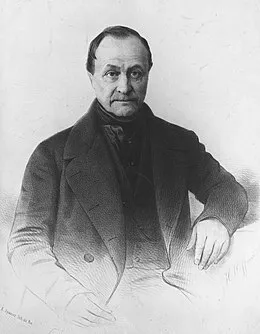


Presentation
Auguste Comte, born on January 19, 1798, in Montpellier and deceased on September 5, 1857, in Paris, was a French philosopher regarded as the founder of positivism and one of the principal forerunners of modern sociology. His work emerged during an era profoundly transformed by the political, scientific, and social consequences of the French Revolution. Convinced that human societies could be studied with a rigor comparable to that applied to natural phenomena, he sought to establish a philosophy capable of unifying knowledge and contributing to the reorganization of the modern world. His thought rested on a fundamental conviction: intellectual progress requires moving beyond explanations based on supernatural or abstract causes to discover the laws governing observable phenomena.
In Discourse on the Positive Spirit, published in 1844, Comte presents the principles of his philosophical method and develops his celebrated law of three stages. According to this theory, human thought passes successively through a theological stage, in which phenomena are explained by supernatural powers; a metaphysical stage, based on abstract entities and principles; and finally a positive stage, characterized by the search for scientific laws. Within his system, this progression offers a general interpretation of humanity's intellectual history. Comte also establishes a classification of the sciences, extending from mathematics to the study of society, in which each discipline builds upon the knowledge developed by those preceding it.
With Discourse on Positivism as a Whole, published in 1848, his thinking acquired a more explicitly political and moral dimension. Comte no longer sought merely to organize scientific knowledge: he aimed to establish the foundations of a society guided by cooperation, education, and concern for the common good. He increasingly emphasized human feelings, solidarity, and what he called the Religion of Humanity, a moral and symbolic system intended to replace traditional religious beliefs without relying on supernatural explanations. This evolution, controversial even among his followers, reveals the ambition of his philosophy: to connect science, collective life, and ethical responsibilities within a comprehensive vision of human progress.
Career
Isidore Auguste Marie François Xavier Comte was born in Montpellier into a Catholic and monarchist family, whose convictions he rejected while still young. An exceptionally talented student, particularly in mathematics, he entered the École Polytechnique in Paris in 1814, at only sixteen years old. The institution temporarily closed in 1816 following conflicts with the restored Bourbon authorities. Comte continued his education independently and, in 1817, met the social thinker and reformer Henri de Saint-Simon, becoming his secretary and collaborator. This experience strengthened his interest in the relationships between scientific development, industrial organization, and social change. Their collaboration ended in 1824 after intellectual and personal disagreements.
In 1825, he married Caroline Massin. The following year, while beginning to present his philosophical ideas publicly, he experienced a severe psychological crisis that temporarily interrupted his work. He gradually resumed his research and undertook the publication of his major Course of Positive Philosophy, whose six volumes appeared between 1830 and 1842. This work explained his understanding of scientific method, his classification of disciplines, and his proposed science of social phenomena. Alongside his philosophical work, he taught mathematics and offered public astronomy lectures intended particularly for working people. Despite the growing importance of his ideas, difficult relationships with academic institutions and persistent financial problems complicated his professional life.
From the 1840s onward, Comte's thought underwent a major transformation. His relationship with Clotilde de Vaux, who died in 1846, strengthened his emphasis on emotions and the affective dimension of human existence. During the revolution of 1848, he founded the Positivist Society and published Discourse on Positivism as a Whole, seeking to translate his principles into a program of social reform. He subsequently developed the Religion of Humanity and wrote the System of Positive Polity, published between 1851 and 1854. This orientation created divisions among his followers, particularly with Émile Littré, who remained more closely attached to the scientific aspects of positivism. Comte continued his work until his death in Paris in 1857. He was buried in Père-Lachaise Cemetery, leaving a body of thought that profoundly influenced the philosophy of science and the emergence of the social sciences.
Key Facts
- One of the founders of sociology: Auguste Comte helped establish both the name and the scientific ambitions of the study of human societies. He distinguished between social statics, concerned with the conditions underlying collective order, and social dynamics, which examined social transformations and the supposed laws of historical progress.
- The celebrated law of three stages: according to Comte, humanity develops through theological, metaphysical, and positive modes of explanation. This theory occupies a central position in his philosophical system, although its linear and universal view of history has been widely challenged by later historical and sociological research.
- A hierarchy of scientific knowledge: Comte arranged the sciences in order of increasing complexity, from mathematics to sociology, through astronomy, physics, chemistry, and biology. He sought to clarify their relationships and explain why the scientific study of society should build upon the achievements of other disciplines.
- A philosophy transformed into a moral project: during the final period of his life, Comte concluded that science alone could not ensure a harmonious social order. His Religion of Humanity, complete with rituals and a commemorative calendar, aimed to encourage collective attachment and altruism, but provoked significant disagreements among positivists.
- A lasting international influence: positivism influenced the development of the social sciences, the philosophy of science, and various nineteenth-century reform movements. Its influence extended notably to Latin America, where Brazil's national motto, “Order and Progress,” preserves an explicit legacy of Comte's philosophy.